

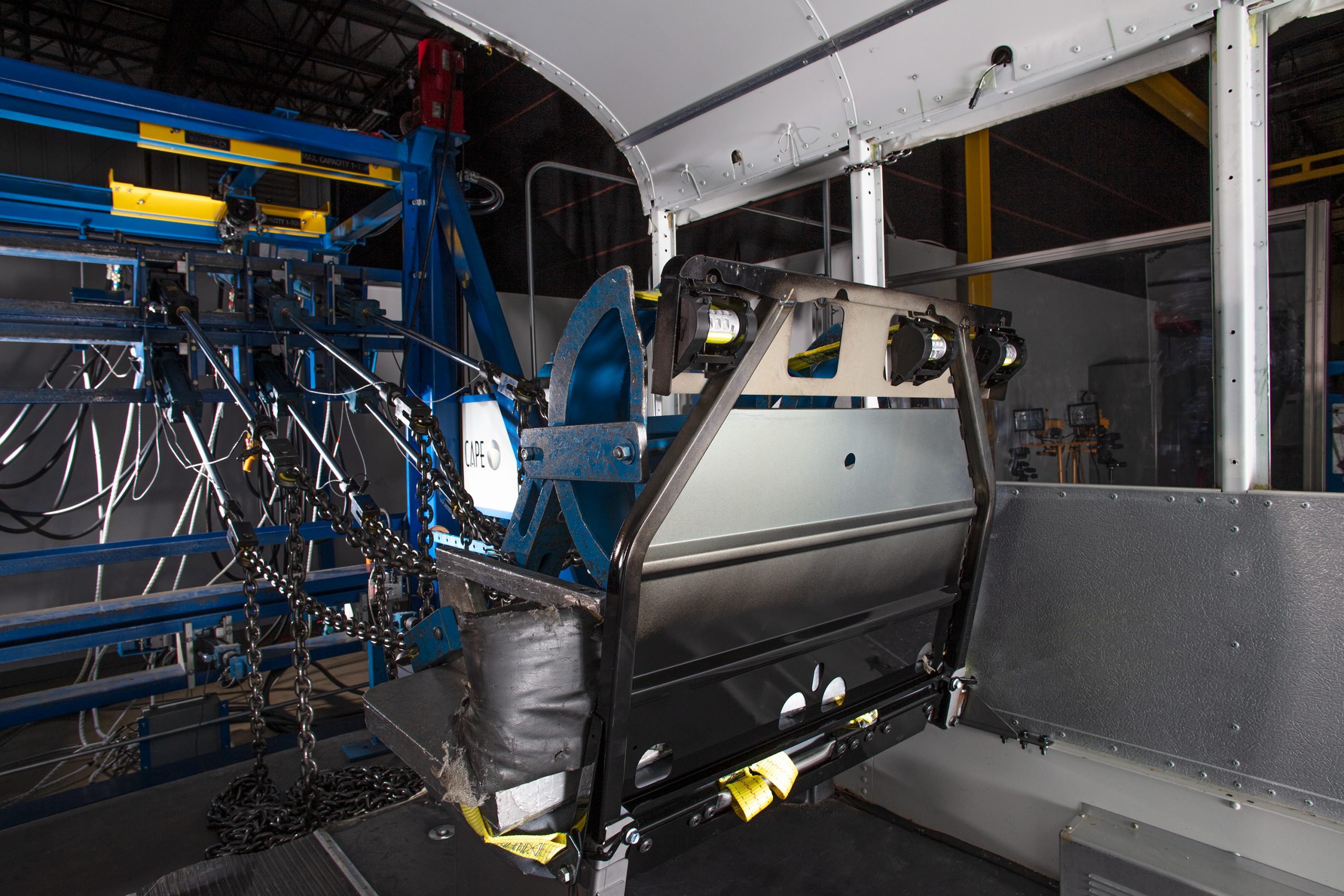
Quasi-Static Load & Pull Testing

Safety-conscious clients conduct quasi-static load testing at CAPE to analyze the integrity of their vehicle anchorages, seating systems, and restraint systems, as well as to document compliance with applicable standards. Static pull testing with a programmable closed-loop hydraulic system demonstrates component strength and helps engineers determine how to strengthen systems to achieve optimal performance.

Quasi-Static & Pull Testing Standards

CAPE can conduct testing in multiple occupant positions to FMVSS 207, 210, 222, and 225, as well as ECE R14, ECE R17, SAE J386, SAE J1948, SAE J2292, FMCSR 393.76, and ISO 6683.

Quasi-Static & Pull Testing Features

  • Analyzes the integrity of vehicle anchorages, seating systems, and restraint systems
  • Capable of conducting new testing to meet school bus seat safety regulations
  • Capable of testing trailer rear impact guards, motorsports nose cones and survivable cells, FMVSS 225 LATCH systems, and roll cages
  • Home to two state-of-the-art quasi-static load testing centers
  • More than 3,000 FMVSS 207/210 pull tests conducted
  • Can test up to four adjacent seating positions simultaneously in a vehicle cab or body section

Discuss Your Quasi-Static & Pull Testing Project

CAPE provides quasi-static and pull testing for vehicle seating systems, anchorages, and components. Tell us about your testing requirements, and our team can help determine the right approach for your project.

Discuss Your Quasi-Static & Pull Testing Project

CAPE provides quasi-static and pull testing for vehicle seating systems, anchorages, and components. Tell us about your testing requirements, and our team can help determine the right approach for your project.

Contact CAPE